Research
My research spans large language models, reinforcement learning, and optimization. My current focus is on LLM post-training, reasoning agents, and reinforcement learning environments. Previously, I studied online learning and optimization algorithms for dynamic pricing and resource allocation problems. My earlier work provides a theoretical foundation that shapes how I think about AI agents: how they learn from feedback, reason efficiently, and make decisions under uncertainty.
- Agentic Post-Training
- Reinforcement Learning
- Simulation
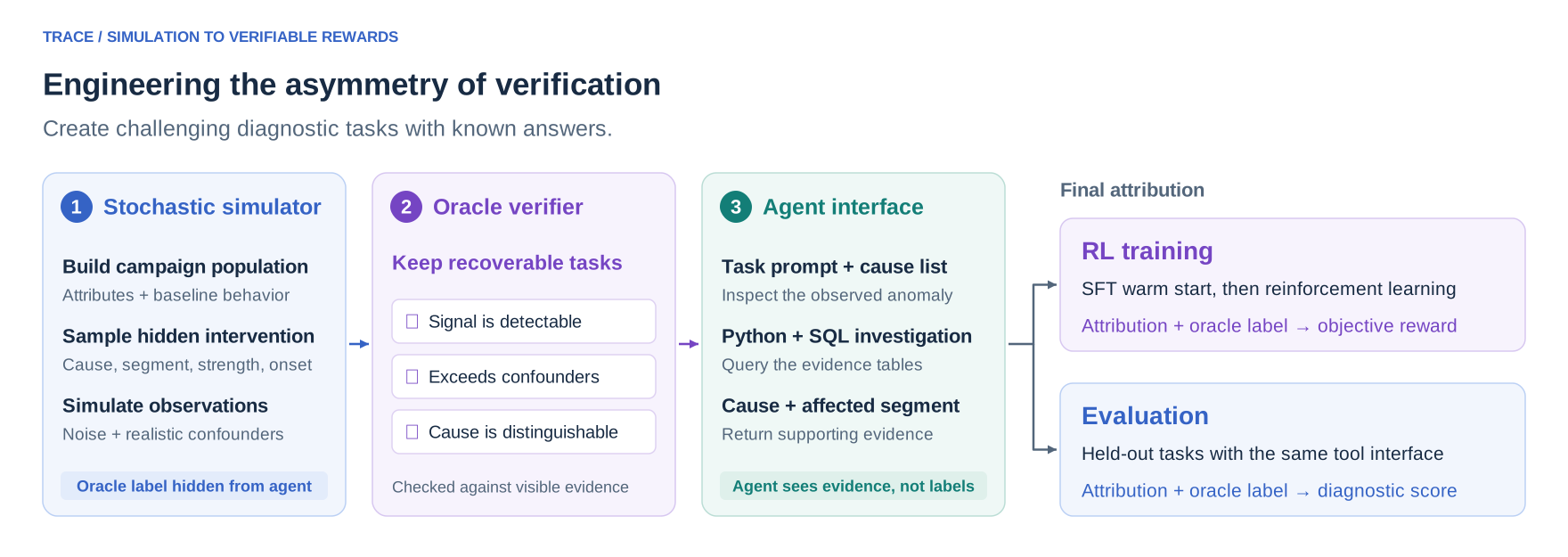
Reinforcement learning with verifiable rewards has been highly effective in domains such as mathematics and coding, where checking an answer is easier than finding one, a property also known as the asymmetry of verification. However, many real-world reasoning tasks do not offer such inexpensive ground-truth verification.
TRACE explores whether we can engineer this asymmetry through simulation: hidden interventions generate noisy, confounded observations, making diagnosis challenging while keeping the underlying cause known and the reward objectively verifiable. On our held-out benchmark, supervised fine-tuning and reinforcement learning improve Qwen3.5-35B-A3B, outperforming all evaluated prompted baselines, including Claude Opus 5. Our results suggest that scalable, objective training signals can be as important as model scale for building capable reasoning agents.
- Optimization
- Online Algorithms
- Revenue Management
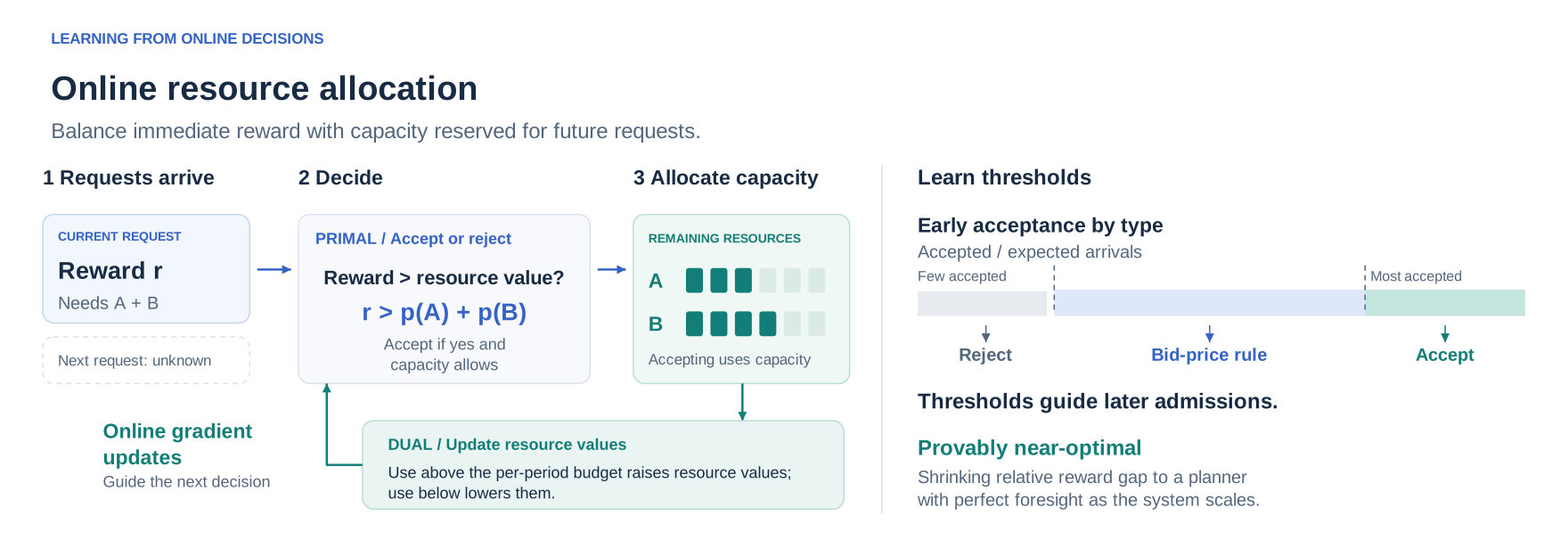
Many real-world allocation problems require making decisions before future demand is known. Accepting a request today uses capacity that may be more valuable tomorrow. Network revenue management is a canonical example: customer requests arrive sequentially, resources are limited, and each decision must balance immediate revenue against the opportunity cost of consuming scarce capacity.
We develop a primal-dual framework that turns this global resource-allocation problem into simple online decisions guided by dynamically updated resource values. The resulting algorithms achieve near-optimal performance guarantees without repeatedly solving large deterministic optimization problems. More broadly, the work shows how dual variables can act as adaptive signals that coordinate sequential decisions under uncertainty.
- Online Learning
- Multi-Armed Bandit
- Dynamic Pricing
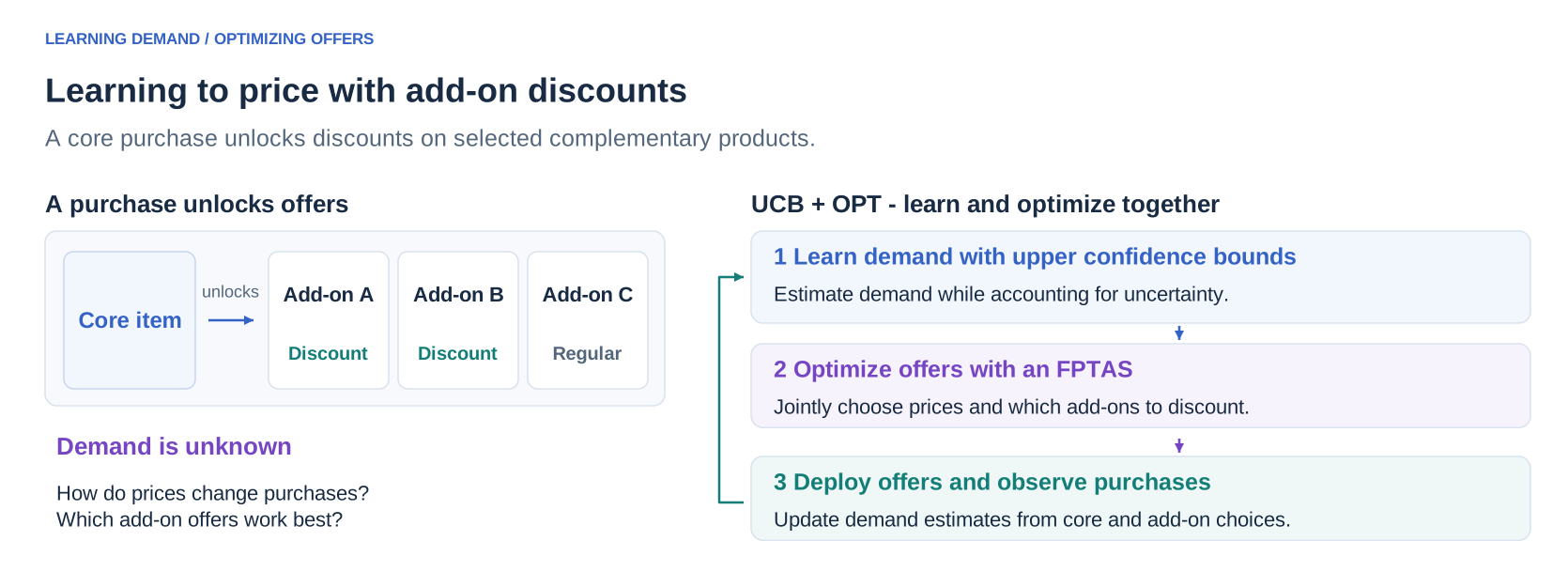
Pricing becomes substantially harder when products interact. A retailer selling a core product may also offer discounted complementary items. This couples several decisions: which products should be discounted, how large should the discounts be, and how should the core product itself be priced? These decisions become more challenging when the relationship between prices and customer demand is unknown.
We address this problem by combining combinatorial optimization with online learning. An approximation algorithm makes the large pricing and assortment space computationally tractable, and an upper-confidence-bound strategy uses observed customer responses to learn unknown demand over time. Together, they yield an efficient learning algorithm with performance guarantees. Experiments using transaction data from a Tmall retailer further demonstrate the value of jointly optimizing prices and add-on discounts.
- Bayesian Learning
- Online Matching
- Bandits
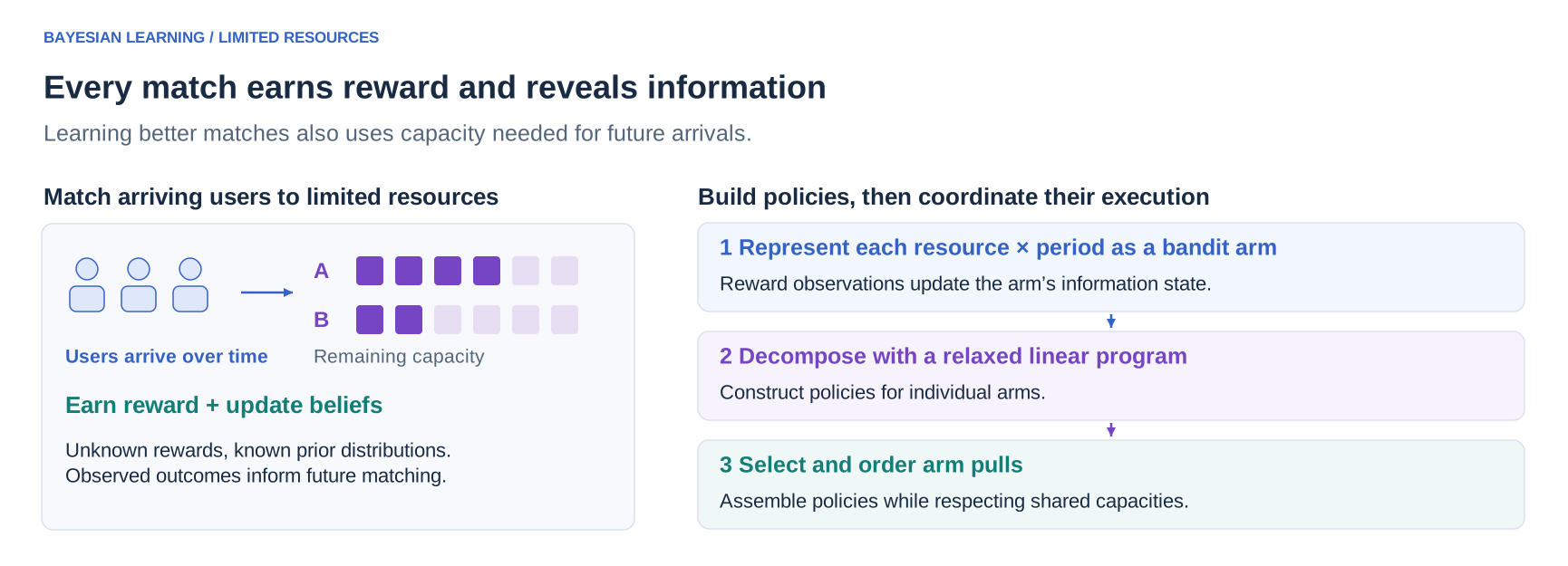
How should a platform allocate scarce resources when the value of each match is initially uncertain? Every allocation serves two purposes: it generates an immediate reward, but also reveals information that can improve future decisions. Learning therefore competes directly with resource conservation—exploration itself consumes the limited capacity we are trying to allocate efficiently.
We formulate this problem as a budget-constrained Bayesian bandit. Our approach first constructs policies for individual arms through a relaxed optimization problem, then coordinates their selection and execution under shared resource constraints. This decomposition turns a difficult high-dimensional adaptive decision problem into tractable subproblems while retaining a provable approximation guarantee relative to the optimal policy.
More publications are available on Google Scholar.